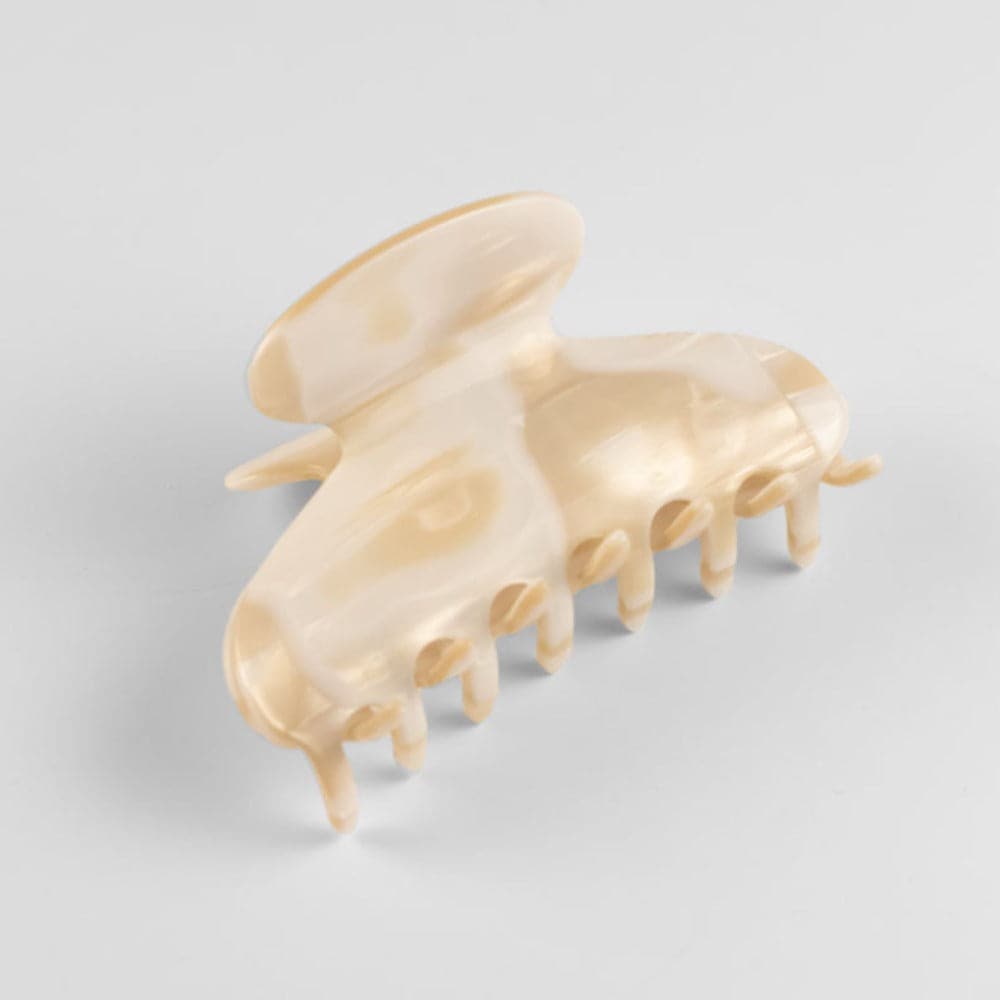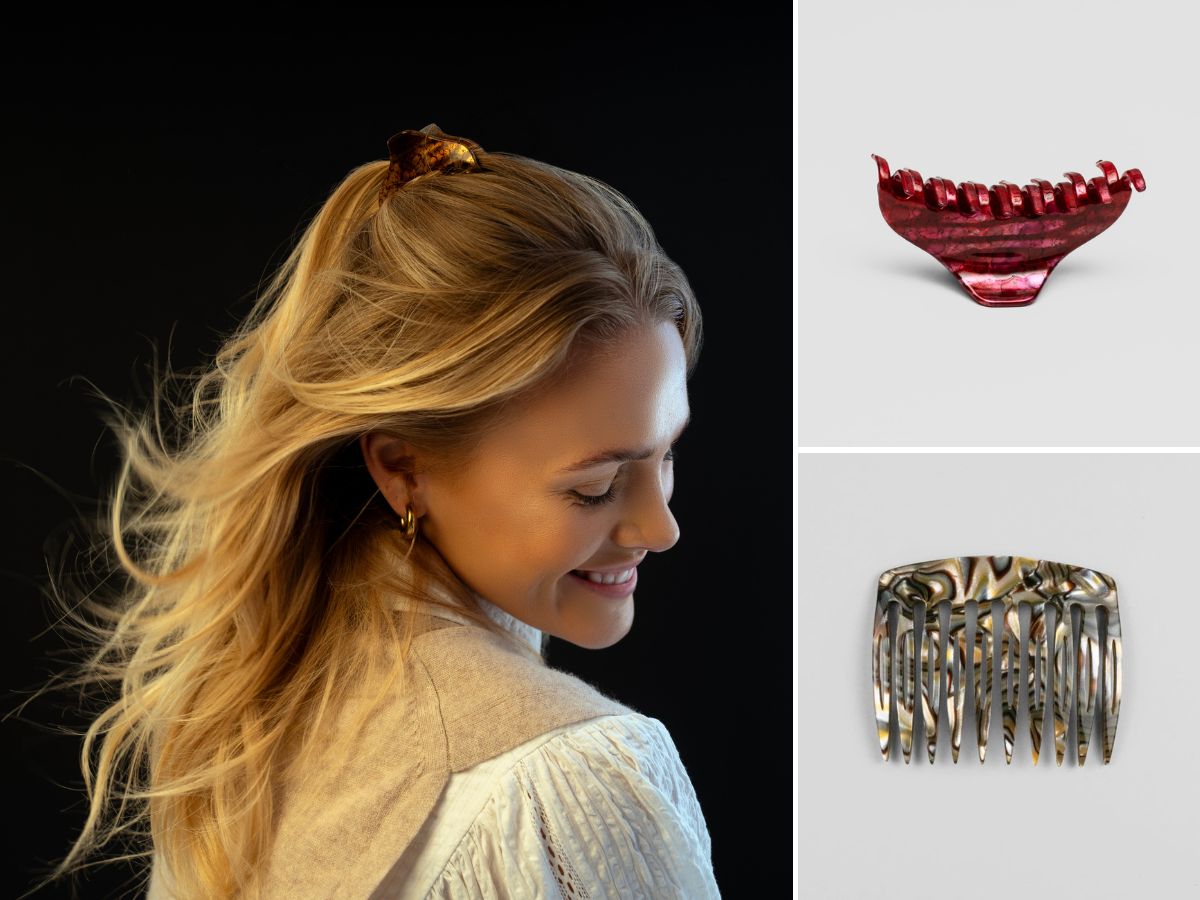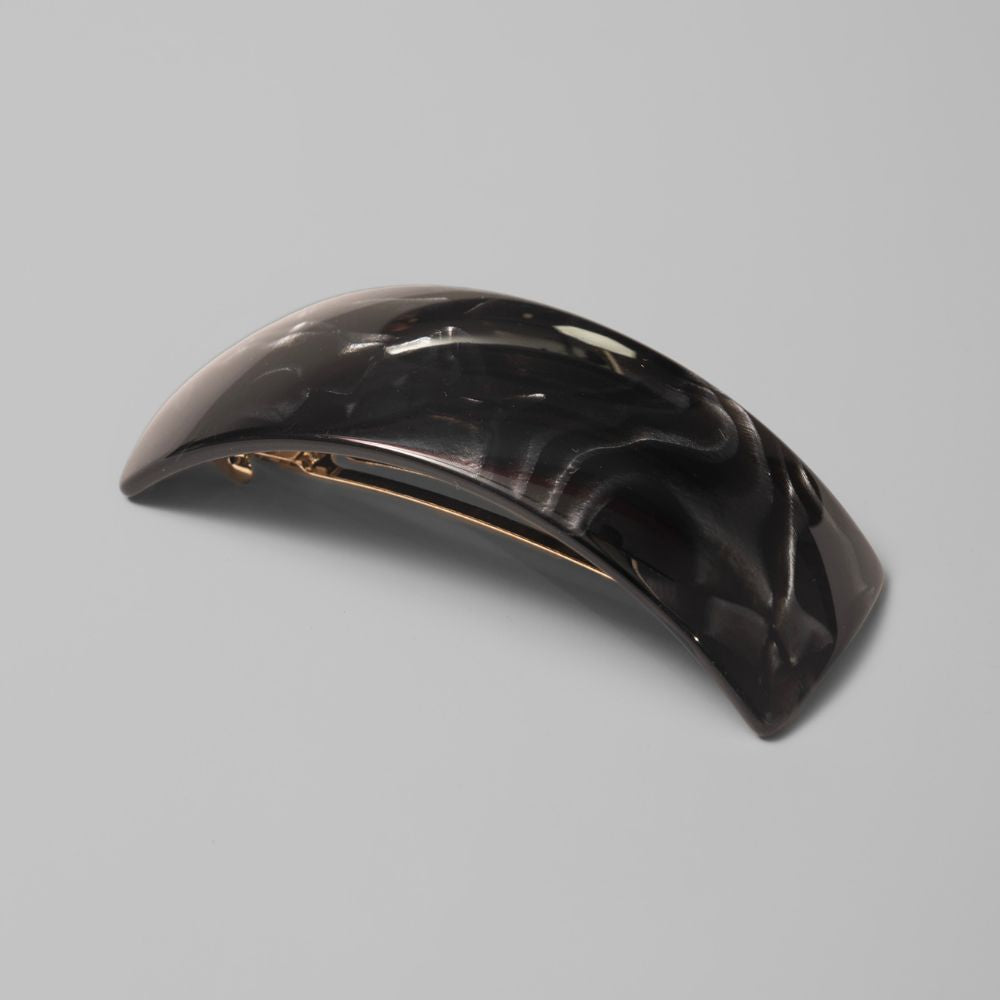






The claw clip was invented in the town where our hair accessories are made. Here is the rest of the story.
Where are TEGEN's hair accessories made?
In Oyonnax, a small town at the foot of the Jura mountains in eastern France.
Every one of our French pieces comes from the same small family-run workshop there. It has been making hair accessories since 1892, and we have worked with them since we started in 2012.
It is not a factory in the way you might picture one. It is a workshop, and the people in it learned the craft from the people before them. Tegen has visited.
Who invented the claw clip?
A Frenchman called Christian Potut, in Oyonnax, in the late 1980s. His company, CSP Diffusion, was founded there in 1986.
His company made combs and yo-yos, and the idea came to him while he sat crossing and uncrossing his fingers. He told the BBC: "I said to myself, I sell combs and clips, why don't I combine the two?"
He protected the design in France but never patented it worldwide, so within a few years it had been copied everywhere. His view on that was generous. "It's been copied," he said, "because only good things are worth copying."
To be clear, that was not our workshop, and we understand the company that first made them has since closed. But the claw clip in your hair, whoever made it, traces back to one small town in the Jura. Ours still come from there.
More on where the claw clip came from
Why Oyonnax?
Because Oyonnax is where French comb making began.
Surrounded by woodland, generations of local families carved combs from boxwood through the winter months, when there was little else to do. Horn came next, then bone, tortoiseshell and ivory. Celluloid arrived in the 1870s. By 1900 the town was supplying combs to the rest of the world.
Then fashion changed. When women cut their hair short in the 1920s the comb trade fell away almost overnight, and most of Oyonnax turned to other moulded goods. The valley is still one of Europe's great centres for them. There is a museum in the town devoted entirely to combs.
Only a handful of workshops carried on making hair accessories. Ours is one of them.
What is cellulose acetate?
It is the material almost everything we sell is made from, and it is the reason our pieces feel different in the hand.
Cellulose acetate is made from plant fibre, wood pulp and cotton, rather than from crude oil. It arrives at the workshop in sheets, and every sheet is patterned differently, which is why no two claws are ever quite the same. It can be cut, shaped, warmed to fit you and polished, and it holds a depth of colour that petroleum plastics never quite manage.
It is also kinder to hair. A hand-polished acetate edge does not catch or snag the way a moulded seam does.
Is it a plastic? Our honest answer.
Which pieces are handmade?
We would rather be precise about this than let you assume. All three ranges are made in the same building, by the same people, from the same French cellulose acetate. What changes is how each piece is shaped.
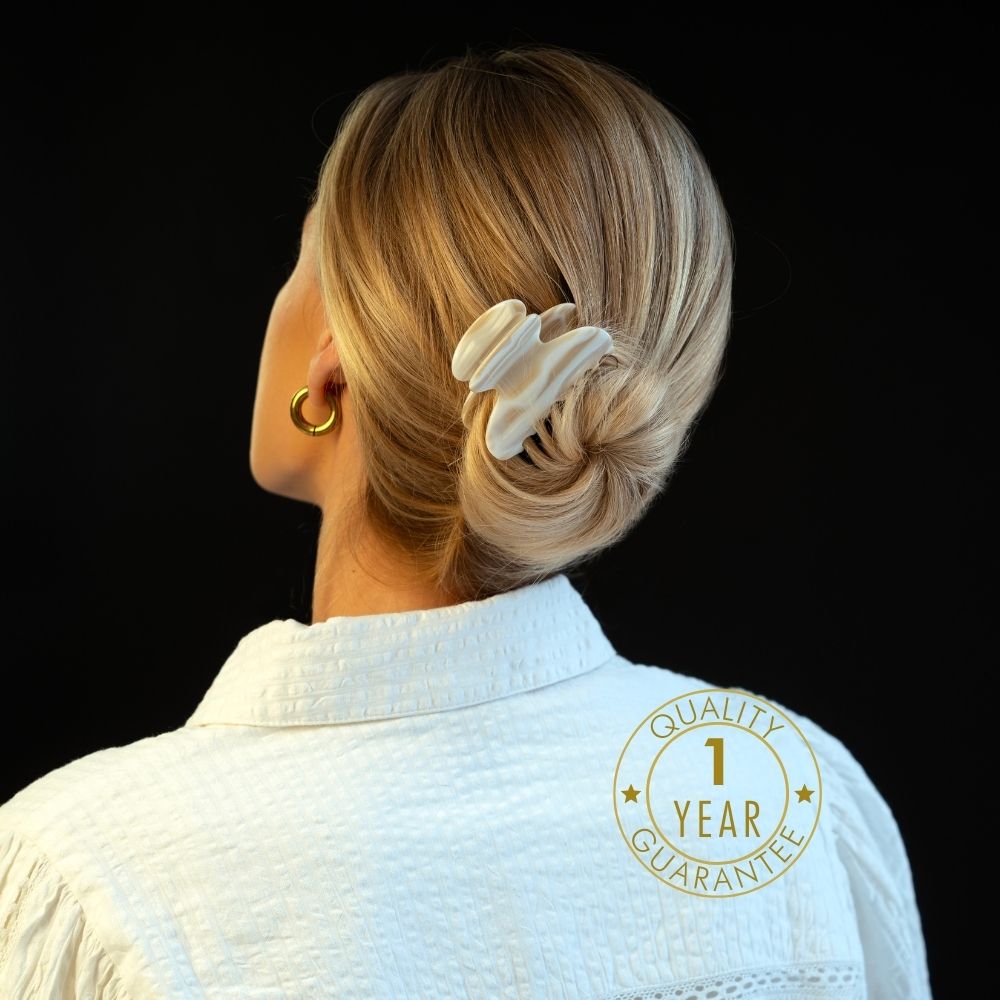
Ooh La La! French Handmade is our signature range, and it is genuinely handmade. Each piece is cut by hand from a patterned sheet, then taken through a ten-step process: shaped, drilled, fitted with a steel clasp, and polished by hand until every edge is smooth. Hand polishing takes the longest and it is the part you notice most. These carry our one-year guarantee.
French Essentials are injection-moulded rather than cut and hand-finished. Same building, same material, a different process and a lower price. Covered for six months.
Hand Painted, which is our Baroque, Botanical and Coastal ranges, are moulded the same way and then painted by hand, so each one differs slightly. Also covered for six months.
What happens to the offcuts?
This is the part we are most pleased about.
When a claw is cut by hand from a sheet, the material left around it would be waste almost anywhere else. Here it does not leave the building. Every offcut is moulded into the French Essentials and Hand Painted ranges, a few steps from where it was cut.
So an Essentials clip is not a cheaper material pretending to be the real thing. It is the same French cellulose acetate, from the same workshop, given a second life. The difference is how it is shaped, not what it is made of.
How long should a French hair accessory last?
Years, not months.
We will not promise you a lifetime, because nothing worn every day lasts forever. But a supermarket claw is moulded in seconds from petroleum plastic, and the spring is usually the first thing to go. Ours are fitted with steel clasps and built to be kept.
"I bought my first barette clip … in 2012 when I came across the shop in Brighton. I still have that clip and use it all the time and it is still perfect."
Catherine, September 2021
"I have some barrettes and claw clips … that must be 10 years old and still going strong."
Sarah, November 2025
That is the whole idea. One beautiful thing, rather than five that break.